
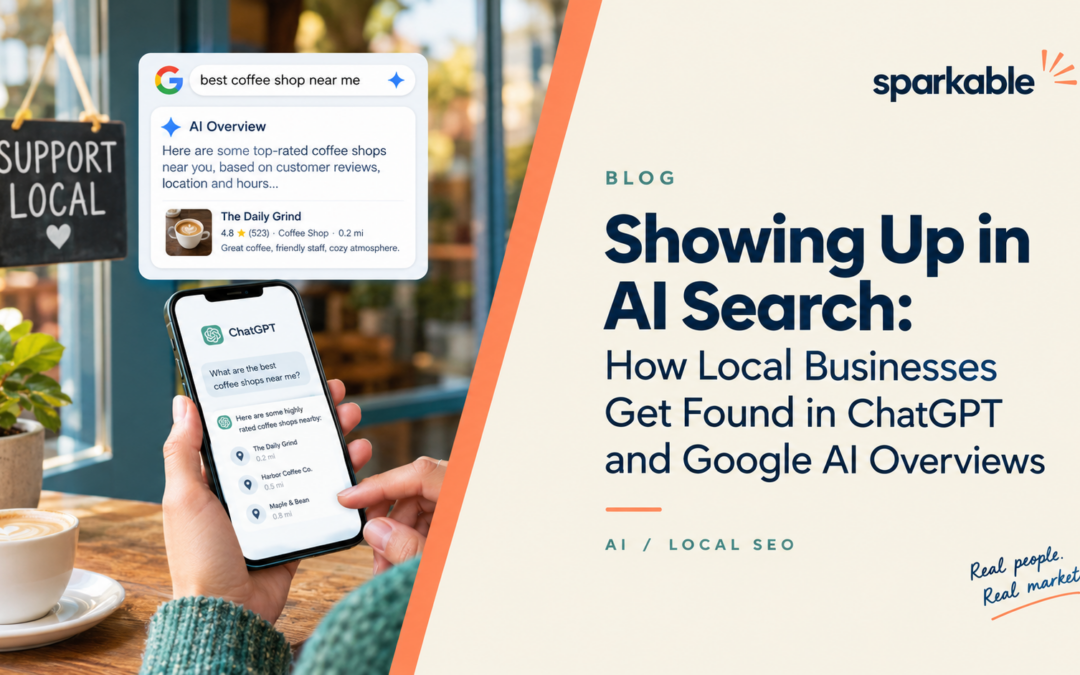
Customers have always searched for local businesses. What is changing is how they ask.
Instead of typing “best plumber near me” into Google, someone might ask ChatGPT, “Who is a reliable plumber in my area who can handle an emergency?” Another person might use Google and see an AI Overview summarizing recommendations, answering questions, and linking to helpful websites.
For small-business owners, this shift can raise some understandable questions. Do you need a whole new SEO strategy? Is your website optimized for AI? Are you already falling behind if you have not started focusing on AI search?
The good news is … you probably do not need to start from scratch. Many of the things that help your business get found in traditional local search also support visibility in AI-powered search experiences. Accurate business information, helpful website content, genuine customer reviews, and a strong local presence still matter.
The difference is that AI tools are changing how people discover, compare, and choose businesses. Understanding that shift can help you make smarter marketing decisions without chasing every new trend.
How Does AI Search Actually Work?
Think of AI search as a new way for people to find and understand information online.
Traditional search engines typically present a list of links, maps, and business listings. AI-powered search experiences can go a step further by summarizing information and answering a question directly, sometimes with links to the sources behind the answer.
These tools do not all work the same way, and there is not one universal formula for appearing in their answers. But they share an important goal: helping people find relevant information they can use.
So, where might that information come from?
Your Google Business Profile
Your Google Business Profile remains an important part of your local online presence. It helps communicate what your business does, where you’re located, when you’re open, and how customers can contact you.
Accurate categories, services, hours, photos and contact information help people understand your business. Keeping this information current is a practical starting point for local search visibility.
Your Website
Your website provides more detail about your expertise, services, service areas, and customer experience.
A clearly written service page can explain exactly what you offer, who you serve, and what makes your business different. A useful FAQ page can answer questions customers commonly ask before reaching out.
Customer Reviews
Reviews offer real-world context about what customers experience when they work with you.
A collection of genuine reviews mentioning your services, professionalism, responsiveness, or service area can help prospective customers understand your strengths. Reviews also contribute to the broader online information people use when evaluating local businesses.
Business Listings and Local Mentions
Your business may appear on directories, local chamber websites, community pages, industry platforms, and local news sites.
When these sources consistently identify your business and accurately describe what you do, they help build a clearer picture of your online presence.
What Is the Same as Traditional Local SEO?
Here is the reassuring part: Good local SEO is still a strong foundation for AI search visibility. The work you have been doing to improve your online presence can continue to pay off.
Keep Your Google Business Profile Accurate
Your profile should reflect your business today, not the version of your business from three years ago.
Review your primary business category, services, business hours, phone number, website, photos and service area. If you offer a new service or have changed your hours, update your profile. Do not treat your listing as a one-time setup task. Make it part of your regular marketing maintenance.
Make Your Website Useful and Easy to Understand
A beautiful website is valuable, but it also needs to communicate clearly.
Visitors should be able to understand what you do, where you work and how to take the next step. Your most important services should have dedicated pages with descriptive headings, helpful explanations and clear contact options.
Technical basics matter, too. Make sure search engines can access your pages, your website works well on mobile devices, and important information is available as readable text.
Maintain Consistent Business Information
Your name, address, and phone number (NAP) should be consistent across important online listings.
Earn Trust Through Genuine Reviews
A steady process for requesting and responding to customer reviews remains worthwhile, especially when managing your local SEO services.
Invite customers to share honest feedback after a completed project, appointment, or purchase. Respond professionally to positive and negative reviews, and use recurring feedback to identify ways to improve your service.
Publish Helpful, Original Content
Your website should answer the questions your customers actually have.
If you’re a landscaper, explain which services make sense for different properties. If you’re a financial professional, clarify the types of clients you serve and the services you provide. If you run a local restaurant, make your menu, hours, location, and reservation information easy to find.
The goal is not to publish more content for the sake of publishing. It is to make your expertise useful and accessible.
What Is Different About AI Search?
If the fundamentals have not disappeared, what should small businesses pay attention to now?
The biggest change is how people ask questions and how search tools assemble answers. Instead of searching with a few keywords, customers can describe a situation, explain their preferences, and ask for a recommendation that fits their needs.
That creates a few opportunities to make your business easier to understand and evaluate.
Write for Questions, Not Just Keywords
Traditional SEO often focuses on the phrases people type into search engines. Those keywords still matter, but conversational searches may be longer and more specific.
Question-based searches reveal what the customer actually needs: a service, a location, a budget, a specific capability, or a level of experience.
Review your website through that lens. Does it answer the questions someone would ask before choosing your business?
Consider adding a useful FAQ section to key service pages. Use clear headings, straightforward answers and specific details about your services and process.
Make Your Business Distinct
Specificity gives search systems and potential customers useful context.
Identify the details that genuinely distinguish your business. That might include the communities you serve, the types of projects you specialize in, the customers you work with, your process, or your professional experience.
Avoid generic marketing language when you can explain what you actually do.
Pay Attention to the Language in Your Reviews
Customer reviews can reveal how people naturally describe your services and what they value most. Review language may provide useful context when people and search tools evaluate businesses. However, there is no guaranteed set of words that will make an AI system recommend you.
Do not coach customers to insert keywords into reviews or offer incentives for particular wording. Instead, invite honest feedback and pay attention to recurring themes. Let your real customer experience shape your messaging.
Build a Stronger Network of Local Mentions
Your website and Google Business Profile are not the only places that matter.
Local business directories, chamber of commerce websites, community organizations, neighborhood publications, event pages and relevant industry directories can help establish your presence beyond your own channels.
These mentions are especially valuable when they accurately identify your business and provide meaningful context about your work.
Make Your Website Information Easy to Access
Your website may look great visually, but important information should also be available in a format search systems can access.
Use descriptive page titles, clear headings, logical internal links and readable text. Keep your service descriptions, contact information and other essential details easy to locate.
Structured data, sometimes called schema markup, can also help search engines interpret certain information about your business.
What Small Businesses Should Not Do
- Do not abandon traditional SEO.
- Do not create dozens of AI-generated pages.
- Do not chase every new AI optimization tool.
- Do not manufacture reviews or local mentions.
- Do not forget the customer after the click.
Conclusion: Be Findable, Be Helpful, Be Yourself
AI is changing how people discover local businesses, but it has not changed what makes a business worth choosing.
Customers still want accurate information, relevant services, trustworthy reviews and a business that understands their needs. Whether they find you through Google Maps, a traditional search result, a ChatGPT recommendation or a local referral, those fundamentals remain valuable.
Start with your Google Business Profile. Check your listings. Make your website more useful. Encourage honest reviews. Share your expertise and stay involved in your local community.
Then keep improving, one practical step at a time.
At Sparkable, we have long believed that effective local marketing comes down to connection, consistency and understanding the people you are trying to reach. AI search adds another layer to that work, but it does not replace the fundamentals.
Not sure where your business stands? Let us start with the basics.
Sparkable offers a free local listing and Google Business Profile audit to help you identify gaps, correct inconsistencies and uncover opportunities to strengthen your local search presence. No hype, no pressure — just a clearer picture of where you are today and what to prioritize next.
Contact Sparkable page to request your free local SEO audit.
Recent Comments