
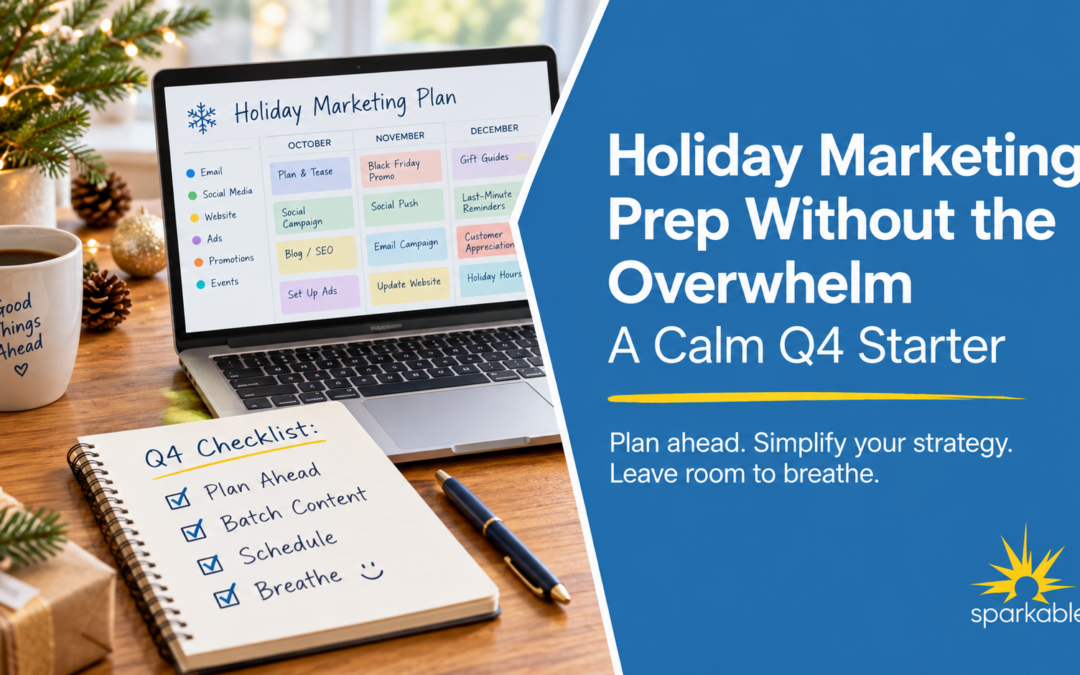
For many small businesses, the holiday season brings a familiar feeling: We need to do everything. And we need to do it now. Holiday promotions, social media, email campaigns, gift guides, special offers and much more. Before you know it, your Q4 marketing plan has turned into a giant to-do list and you’re spending more time trying to keep up than actually connecting with customers.
But holiday marketing doesn’t have to work that way. The most effective Q4 marketing isn’t necessarily the marketing with the most moving parts. It’s the marketing that’s planned early, focused on what matters, and built around a system you can actually maintain.
This year, try a different approach: less hustle, more structure.
Here’s how to get your holiday marketing moving without letting it take over your business.
Pick 2-3 Priorities
One of the fastest ways to create marketing overwhelm is to try to do everything.
Instead, start by asking:
What actually needs to happen for our Q4 marketing to be successful?
Maybe your priorities are:
- Drive holiday sales
- Generate more leads
- Stay visible to existing customers
- Promote a specific seasonal service
- Increase repeat purchases
- Fill your holiday calendar
- Build awareness for the new year
Choose two or three priorities and let them guide your decisions. That means if a marketing idea doesn’t support one of those priorities, it can wait. You don’t need to be everywhere. You need to be intentional about where your customers are and what you want them to do.
Build Your Holiday Marketing Around a Few Big Moments
You don’t need a completely different campaign every week. Instead, look at the major moments in your Q4 calendar and build around them.
For example:
October:
Plan, tease, and build awareness.
November:
Promote key offers and capitalize on holiday shopping momentum.
December:
Focus on last-minute purchases, gift ideas, deadlines, and customer appreciation.
Then identify the dates that really matter to your business. Once those anchor dates are in place, the rest of your content becomes much easier to plan.
Batch Your Content Before the Rush
One of the biggest sources of marketing stress is constantly creating content at the last minute.
You write one social post. Then you realize you need an email. Then you need a graphic. Then you remember your website needs updating.
Sound familiar?
Batching can change that. Set aside a block of time to create several pieces of content at once.
For example, one holiday promotion could become:
- An email
- Three social posts
- A blog or website feature
- A short video or Reel
- A Google Business Profile update
- A customer reminder
- A follow-up post
One idea doesn’t have to equal one piece of content. Think in campaigns, not individual posts.
Schedule What You Can, Early
You don’t have to wait until December to start your December marketing.
If you already know about an upcoming promotion, event, deadline, or holiday message, get it into the system now.
Schedule your social posts.
Draft your emails.
Prepare graphics.
Update landing pages.
Set up ad campaigns.
Create reminders for anything that can’t be scheduled.
The goal isn’t to lock your entire Q4 in stone; it’s to remove as many future decisions as possible.
Create a “Good Enough” Content System
Here’s something small businesses don’t hear enough:
Not every piece of content needs to be perfect.
During a busy season, consistency often matters more than creating the most polished post you’ve ever made.
Create a few repeatable content categories you can rotate through:
Promote:
What’s available, what’s on sale, or what’s coming up?
Educate:
What can you help customers understand?
Connect:
What can you share that shows the people behind the business?
Remind:
What deadlines, events, or seasonal details should customers know?
Appreciate:
How can you thank your customers and community?
Having these categories gives you a framework when the content calendar starts looking intimidating. You don’t need to start from scratch every time.
Protect Your Energy, Too
Your marketing plan should account for the fact that you’re running a business while doing all of this. That means building realistic expectations into your Q4 strategy.
If you normally post five times a week but know the holidays will be especially busy, consider whether three strong posts would be more sustainable.
If you don’t have the bandwidth to launch a brand-new campaign on every platform, don’t.
If a particular marketing channel consistently takes hours but produces little value, Q4 might be the perfect time to rethink it.
Marketing should support your business, not consume all of your time and energy. The goal isn’t to do more. It’s to make what you’re doing work harder.
Leave Room for the Unexpected
A good Q4 plan isn’t one where every minute is scheduled. It’s one that gives you enough structure to handle the things you didn’t plan for.
A customer story takes off.
A new partnership opportunity comes up.
A product sells faster than expected.
A local event creates a timely content opportunity.
If your entire marketing calendar is packed to the minute, you won’t have room to take advantage of those moments. Build your foundation early, then leave some breathing room. That’s what makes a marketing system flexible instead of fragile.
Make Q4 Work Smarter, Not Harder
Holiday marketing will always come with some extra activity. But extra activity doesn’t have to mean extra chaos.
Start early. Focus on what matters. Batch what you can. Schedule ahead. Repurpose your best ideas. And give yourself permission to leave some things off the list.
Because a successful holiday marketing strategy isn’t just about reaching more customers. It’s about building a system that lets you do that without burning yourself out in the process.
Not sure where your marketing stands before Q4 gets fully underway?
Sparkable’s free marketing diagnostic can help you identify what’s working, what’s getting in the way, and where a few strategic changes (such as SEO, content creation, social media management, or web development) could make the biggest difference.
Recent Comments