
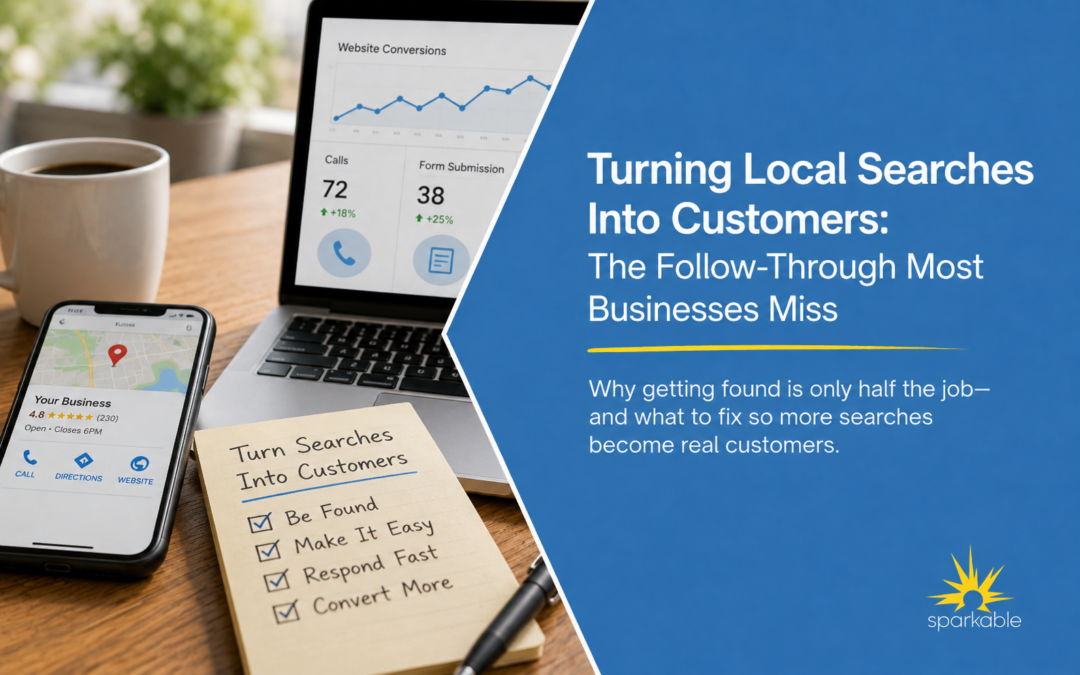
You worked to get found. Your Google Business Profile is optimized. You’re showing up in local searches. Maybe your website is ranking, too. So why aren’t those searches turning into more calls, bookings, and customers?
Here’s the thing: visibility is only the first step.
We see this all the time. A small business invests time and energy into improving its local SEO, starts appearing more often in Google, and expects the phone to start ringing. But getting in front of a potential customer and making it easy for them to take the next step are two very different things.
The real customer journey often looks something like this:
Google search → Google Business Profile → website → action
And at every step along the way, there’s an opportunity for someone to say, “Never mind.” That’s the visibility gap.
You can rank well and still lose customers because your website takes too long to load, your phone number is hard to find, or your booking process requires too many clicks. Or perhaps someone fills out a form and waits hours, or even days, for a response. Local SEO gets people to your digital doorstep; what happens next determines whether they actually walk through the door.
The visibility gap: Where are potential customers dropping off?
Imagine someone searches for exactly what you offer. They find your business on Google, click your Google Business Profile, visit your website.
And then… nothing.
Maybe they can’t immediately tell what to do next. Maybe the page they land on is cluttered or outdated. Maybe the service they searched for is buried somewhere in your navigation. Maybe they’re on their phone and the “Contact Us” button is practically impossible to find.
It doesn’t take much friction to lose a potential customer, especially when they can simply hit the back button and choose the next business in the search results. That’s why rankings alone don’t tell the whole story.
The better question is:
What are people doing after they find you?
Your local SEO strategy should be connected to the actions that actually matter to your business. More visibility is great but visibility without conversion can turn into a lot of activity without a lot of results.
Your Google Business Profile is more than a listing
Your Google Business Profile is often one of the first interactions a potential customer has with your business. It’s not just a place to display your hours and address. It’s part of your conversion path.
When someone lands on your profile, they should be able to quickly answer a few important questions:
- Is this business right for me?
- Are they open?
- Where are they located?
- What do they offer?
- Can I trust them?
- What should I do next?
Your business description, categories, photos, reviews, services, website link, phone number, and available action buttons all play a role in moving someone closer to becoming a customer. Think of your profile as a digital front door. If someone is interested enough to find you, don’t make them work harder than necessary to take the next step.
Make the next step obvious
Every important page on your website should have a clear path forward.
Depending on your business, that might be:
- Call Now
- Book an Appointment
- Request a Quote
- Order Online
- Get Directions
- Schedule a Consultation
The key is clarity.
If someone has to scroll through three sections, open a menu and visit a separate contact page just to find out how to reach you, there’s a good chance you’re losing potential customers along the way.
A clear call to action doesn’t have to be complicated. Sometimes the simplest improvement is making the phone number visible at the top of the page or adding a prominent booking button where people can actually find it.
Small friction points can create big drop-offs
Most conversion problems aren’t dramatic. They’re usually small things that have been sitting on a website or customer journey for months, or years, without anyone noticing.
Here are a few common ones we see:
- Your website takes too long to load
- Your phone number is hard to find
- Your landing page doesn’t match what they searched for
- Your booking process feels like a chore
The follow-up problem you can’t ignore
Let’s talk about what happens after someone does take action. A potential customer fills out your contact form.
How long does it take for someone to respond? An hour? A day? Three days?
In the time between submitting that form and hearing back from you, that customer may have contacted three other businesses.
This is especially important for local businesses competing for customers with immediate needs. Whether someone is looking for a contractor, booking a service, making a reservation, or requesting information, response time can directly affect whether that lead becomes a customer.
You don’t need a complicated system to improve this.
Start by asking:
- Who receives new leads?
- How quickly are they notified?
- Who is responsible for following up?
- What happens after business hours?
- Are leads ever slipping through the cracks?
Sometimes the biggest conversion opportunity isn’t getting more leads. It’s doing a better job with the ones you already have.
A quick local SEO and conversion audit you can do today
You don’t need to rebuild your entire website to find opportunities for improvement. Take 15 minutes and walk through your customer journey yourself.
Try searching for your business and ask:
On Google:
- Is your Google Business Profile complete and accurate?
- Are your hours, phone number, website, and location easy to find?
- Do your photos and reviews create a strong first impression?
- Are your services clearly represented?
- Is it obvious what someone should do next?
On your website:
- Does your website load quickly?
- Is it easy to use on a phone?
- Can visitors immediately understand what you offer?
- Is your phone number visible?
- Is there a clear call to action on every important page?
- Do your local landing pages match what people are actually searching for?
When someone reaches out:
- Does your form work?
- Do new inquiries go to the right person?
- How quickly do you respond?
- Is your booking process simple?
- Are you tracking whether calls, forms, bookings, or website visits are actually turning into customers?
You may be surprised by what you find. And don’t worry this isn’t about achieving digital perfection. Most businesses have a few gaps. The goal is simply to identify the places where interested customers are getting stuck, confused, or disappearing. Because small improvements can make a meaningful difference.
Local SEO should lead somewhere
At Sparkable, we believe local SEO is about more than getting a business to the top of a search result. Rankings matter. Visibility matters. A well-optimized Google Business Profile matters. But ultimately, the goal is to help your business grow.
That means connecting your local SEO conversion strategy to real outcomes: more phone calls, more appointments, more bookings, more foot traffic, and more customers. The strongest strategy looks at the entire journey from the moment someone searches for a business like yours to the moment they decide to take action.
Because getting found is only half the job. The follow-through is what turns searches into customers.
Wondering where your follow-through is breaking down?
If you’re getting visibility but not seeing the calls, leads, or bookings you expected, it may be time to look beyond your rankings. Sparkable’s local SEO and conversion diagnostic can help identify where potential customers may be dropping off and uncover practical opportunities to make the path from search to action a little easier.
No jargon. No pressure. Just a clearer picture of what’s working, what isn’t, and where a few smart changes could make a real difference.
Ready to see where your follow-through could be stronger? Let’s take a look.
Recent Comments