
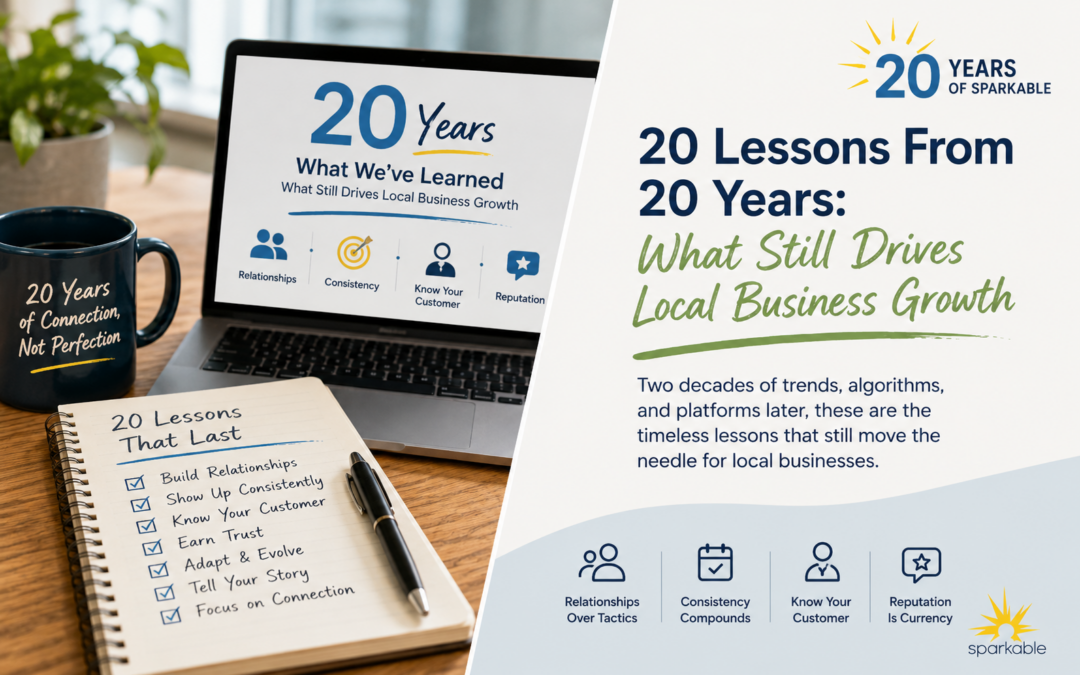
Two decades, four business partners, one newsroom, and a lot of hard lessons about what actually grows a local business: kindness, patience, and showing up.
Twenty years is a long time in marketing. In two decades we’ve watched platforms come and go, algorithms change overnight, websites evolve from static brochures into sales tools, and social media rewrite how businesses connect with customers.
We’ve seen “the next big thing” become the thing everyone forgot six months later. But through all of it, something interesting happened:
The fundamentals of growing a local business haven’t changed nearly as much as the tools have.
Before I get to the lessons, I want to tell you where they came from, because they didn’t come from a textbook.
I started in this industry in 2007 as a copywriter and was told, more than once, that my real job was to make coffee.
I’ve had a piece of copy thrown in the trash without being read because it wasn’t in the right format, by someone who wouldn’t tell me what the right format was. I once kept my mother and grandmother waiting in a parking lot on my grandmother’s birthday because a draft was never going to be perfect enough for me to leave at five.
I spent 2008 to 2013 as a newspaper reporter, showing up at 7:30 in the morning and often ending the day in a folding chair at a planning board or school board meeting.
Between 2015 and 2023, I went through four different business partners at Sparkable. In 2022, I told the last one that either he was leaving or I was, but either way I was going to keep doing marketing. He left. I stayed.
I’m not sharing any of this to complain. I’m sharing it because every one of those moments taught me something about how people deserve to be treated, and since going solo I’ve built Sparkable’s culture around four words: kindness, empathy, education, and excellence.
So here they are. Twenty lessons from twenty years. They’re the things that held up. Several of them I learned the hard way.
1. Relationships beat tactics
The best marketing strategy in the world can’t replace a strong relationship with your customers. A customer who trusts you is more likely to buy from you, come back, recommend you, leave a review, and choose you again the next time they need what you offer.
That trust is built through hundreds of small interactions, not one clever campaign. I learned this the slow way. Every partnership that didn’t work, every client that did, came down to the same thing: did the people involved actually trust each other?
2. Give value before you ask for anything
A few years ago I reached out to Joe Martucci, a meteorologist I’d been following since his days at The Press of Atlantic City, and said something like: “I like what you do, and I’d like to support it however I can.” We had a lot in common. We’d both worked at newspapers. We’d both had to figure out how to build something of our own after that industry changed.
We started with a trade – some marketing help in exchange for a mention on his social channels. No scope, no invoice. Today, Cup A Joe Weather and Drone has a new website and a streaming weather channel we’re both genuinely proud of, and it’s one of the relationships I value most.
Gary Vaynerchuk calls this “give value first.” I didn’t know it was a strategy at the time. It just felt like the right way to treat someone doing good work.
3. Your community is part of your brand
Local businesses have an advantage national brands can’t replicate – proximity. You know the community. You know the people. You may sponsor the Little League team, show up at local events, support other businesses, or simply recognize customers when they walk through the door.
Being part of your community isn’t just good citizenship. It’s good business.
4. Repeat customers are a growth strategy
It’s easy to become obsessed with the next new customer, but sometimes the smartest growth opportunity is the one who’s already bought from you. A follow-up email. A seasonal reminder. A personal check-in. A reason to come back.
Keeping existing customers engaged is almost always more valuable than starting from zero.
5. Reputation is currency
Before people call, click, or walk through your door, they’re checking what other people have said about you. Reviews matter. Recommendations matter. Community perception matters.
Reputation isn’t something you can manufacture overnight. It’s built customer by customer, interaction by interaction, and it’s the one asset nobody can take from you.
6. Consistency beats going viral
Going viral sounds great, but viral isn’t a strategy. Showing up is.
A business that regularly publishes useful content, responds to reviews, updates its Google Business Profile, follows up with customers, and stays visible in the community has a far stronger foundation than one that posts five times one week and disappears for three months.
7. Small kindnesses compound
When I was at the newspaper, my mentor Steve Prisament and I went to the pretzel factory every deadline day – Wednesday – and brought back a box for the newsroom. It cost almost nothing. It made the room better. Eventually our editor told us to stop.
I didn’t understand it then and I don’t understand it now. Small, consistent acts of generosity are the business. Updating a few website pages, asking recent customers for a review, sending a thank-you that wasn’t required – none of these change a business overnight. Repeated over months and years, they’re the whole thing.
8. Your marketing shouldn’t depend on anyone’s motivation – including yours
If your marketing only happens when you have extra time, it won’t happen very often. That’s why systems matter – a content calendar, reusable templates, scheduled posts, a review process, a monthly look at your numbers.
The harder version of this lesson took me four business partners to learn – never expect anyone to work as hard as you do, even if they’re an owner. That’s not cynicism. It’s just true, and it’s freeing once you accept it. Build systems that don’t rely on any one person’s effort on any given day, and the business keeps moving.
9. Your website is never really “done”
We hear it all the time – “We just updated our website.” But your business isn’t done changing. Your services change. Your customers change. Search behavior changes. Your website should evolve with the business.
10. Visibility without follow-through isn’t growth
Getting found is only half the job. Someone discovers you through Google, visits your website, finds you through a referral. Then what?
Visibility creates opportunities. Follow-through turns them into customers.
11. Show up and listen
From 2008 to 2013 I covered every city council, zoning, planning, and school board meeting in Ventnor, Margate, Longport and Somers Point. Not the exciting ones. All of them. Most nights nothing dramatic happened.
But I got more stories, more sources, and more genuine connections from sitting in those rooms than from anything else I did as a reporter, because people notice who shows up, and people will tell you almost anything if you give them the room to tell it.
That’s the core of how Sparkable works today. Every client has a different goal and a different vision for what they’re building. Our job starts with listening long enough to understand it.
12. Stop talking like a marketing department
Your customers don’t use industry terminology. They ask questions, describe problems, and search for solutions in their own words. The best marketing sounds less like a brochure and more like a helpful conversation.
13. Answer the questions you hear every day
If customers keep asking the same question, that’s a content opportunity. Answer it on your website, in emails, on social media, in your FAQs. The questions your team answers every day can become your most valuable marketing.
14. Specific beats generic
Specific examples are more believable. Instead of saying you’re responsive, explain how quickly customers can expect a reply. Instead of saying you have experience, show the projects. Instead of saying customers love you, let their reviews tell the story.
15. Connection over perfection
I spent the early part of my career around people for whom nothing was ever good enough, and I absorbed more of that than I’d like to admit. For years I did things the hard way because I thought the hard way was the right way.
Here’s what I know now – customers don’t expect a small business to look like a national brand. Trying too hard to look polished can make you less relatable, not more. Show the people behind the business. Share the story. Show the work in progress.
Perfect isn’t persuasive. Connection is. “Connection Over Perfection” has become a bit of a motto around here, and it’s the reason I don’t run this agency the way I was taught to.
16. The tools will change. Your purpose shouldn’t.
Twenty years ago nobody was talking about TikTok, AI, or voice search. We are now, and there will be something else five years from today. That’s fine. Successful businesses adapt their tools without reinventing who they are. Your platform can change. Your message shouldn’t change every time a new feature appears.
17. Don’t chase every trend
Just because everyone’s talking about a new channel doesn’t mean your business needs to be on it. Ask better questions: Is my audience there? Does it support my goals? Can I maintain it consistently? Sometimes the smartest marketing decision is deciding what not to do.
18. Data should inform, not control
Analytics can tell you where traffic comes from, what people click, and where opportunities may exist. But numbers don’t tell the whole story. A campaign may bring fewer clicks but better customers. A page may have low traffic but produce your best leads. Use the data, then apply human judgment.
19. Respect people’s time – yours included
Years ago we lost a municipal RFP we’d worked hard on because the bid got to city hall too late. Not because the work was bad, but because someone I was in business with didn’t respect how long it takes to print a proposal and drive it from Atlantic City.
That one stung, and it taught me something I now apply everywhere – activity is not progress. More posts don’t automatically mean more customers. More traffic doesn’t automatically mean more revenue. And a great plan that misses the deadline is not a great plan. The real question isn’t “how much are we doing?” It’s “is this actually moving the business forward, on time, with everyone’s time respected?”
20. Kindness is the strategy
If one lesson ties the other nineteen together, it’s this:
People do business with people they know, like, trust, and remember.
I’ve been on the receiving end of the other approach. I know what it feels like to be told you’re bad at everything, to have your work dismissed unread, to be made to feel like your time and your family’s time didn’t matter. None of it made me better at my job. It just made me sure about what kind of business I wanted to build when it was finally mine to build.
Since 2023 I’ve tried to run Sparkable on kind candor – being honest, always, but with kindness attached. Telling a client the hard thing in a way they can actually hear. Giving a teammate real feedback without ever making them feel small. Sticking up for yourself and for your people without turning it into a fight. I wish I’d learned that sooner. I’m glad I learned it at all.
The technology, platforms, and algorithms will keep changing. Kindness, empathy, patience, and showing up don’t go out of style.
Twenty years later, we still believe in fundamentals
After 20 years, we’ve learned that great marketing isn’t one magic tactic. It’s a collection of smart, consistent, human habits that reinforce each other. At Sparkable we’ve never believed marketing needs to be perfect. It needs to connect.
If you’d like to sharpen your local SEO, improve your website, build a marketing system that doesn’t depend on motivation, or simply figure out what to focus on next, sometimes an outside perspective helps you see the opportunity more clearly.
Ready to turn connection into growth? Let’s start the conversation.
Recent Comments